For more than 20 years, my advice as a former consultant to companies on enterprise software was simple: buy the best-fit standard ERP and adapt your processes to it. Bespoke software was for organizations with deep pockets or no alternative.
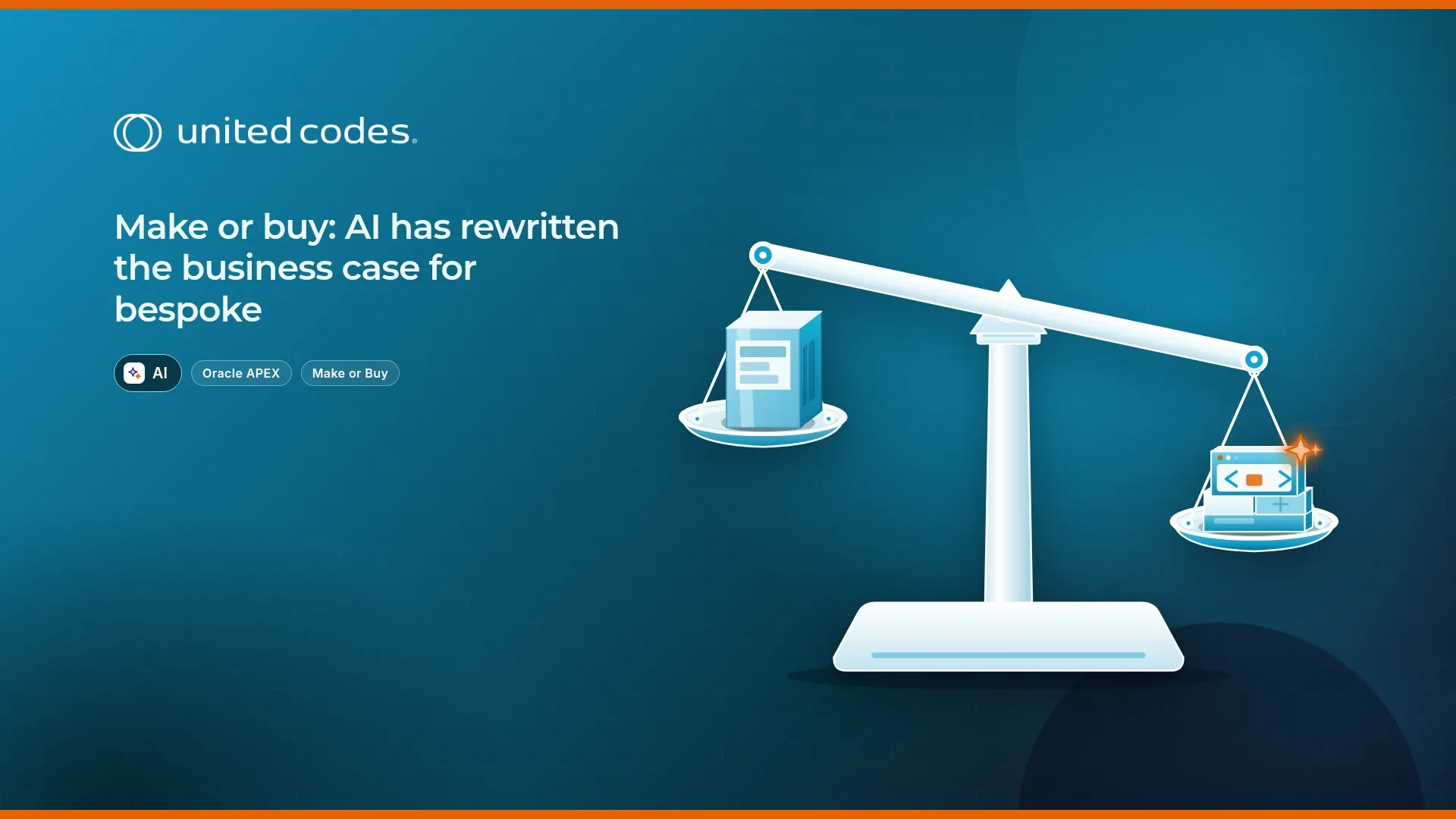
AI has completely changed this. As we rebuild our APEX software development process to become agentic, we’ve seen the cost of building and maintaining custom software drop enough that the make-or-buy question deserves a new answer. Not bespoke everywhere, but bespoke where your processes are your competitive edge.
The old rule: adapt or pay
The standard ERP pitch was rational. Vendors bundle best practice, upgrades, and support. Customization was the expensive exception: every modification had to be built, tested, documented, and carried through each upgrade. Everybody fears the integration hell…
So the main advice that followed was “stay close to standard”. Organizations reshaped their processes to fit the ERP package, and the processes that set them apart were often the first to be flattened or remained manual. Those that refused to stay close to the standard paid for it in customization projects that ran over budget and turned every upgrade into a project of its own.
How AI changed the cost of bespoke software
The cost of bespoke software development was never just writing the code. It was ensuring a full lifecycle: analysis, building, testing, documentation, and keeping all of it current for years. AI agents now carry a large share of exactly that work, not just the build.
In our own rebuild delivery process at United Codes, we have agents generate application logic against our best practices and standards. Testing and documentation are produced as part of the build, not as a separate phase that gets skipped when budgets tighten. We track human time and token spend per delivery, so the savings we claim are measured, not assumed.
This experience now allows us to be confident of the effect on the business case: both costs that made bespoke unattractive, the initial build and long-term maintenance, have moved down. A make-or-buy comparison made on pre-AI development costs is out of date.
Standard core, bespoke edge: what to buy and what to build
This isn’t an argument against standard ERP. Most basic processes like finance, payroll, procurement, or standard logistics work the same way in most companies and gain nothing from being unique. Buy them, and stay close to those standards.
The opposite holds for the processes that make you win: how you plan production, price a specific quote, run a specific supply chain, or serve your customers. That’s where a standard package forces you to look like your competitors. Those processes are now worth building on a platform like Oracle APEX that sits on the same database as your core data.
The test for each business process stays a single question: does doing this differently make us money?
We frame it as ‘standard core, bespoke edge, intelligent everywhere’. The third part is what makes the edge worth building today. Intelligent everywhere means AI isn’t a separate tool next to your application, but built into the APEX app itself, at the point where the work happens:
- A planner gets a suggested production schedule inside the planning screen.
- A quote is pre-filled from the customer’s order history and margin rules.
- Users ask questions of their own data in plain language instead of waiting for a report.
Because the app runs on the same Oracle database as your core data, these use cases work on live, governed data, not on a copy exported to an external AI tool. A standard package gives you the AI features its vendor chose. A bespoke edge lets you put AI exactly where your competitive advantage sits.
The fair objection
The strongest case against bespoke is ownership. Custom software needs people who understand it, a supplier that’s still around in ten years, and their discipline to keep it secure and documented. Many organizations have an old Forms or Access application that proves the point: built fast, never documented, and now a risk.
That concern is valid, and AI vibe coding without governance makes it even worse, not better. The answer is to treat bespoke as a governed product: one architecture, automated testing, documentation that stays current, and a partner accountable for support. It’s also why we keep the bespoke scope narrow. Every custom module must earn its place against the standard ERP alternative.
Where to start
Our advice to organizations looking at their business processes and applications: Split your processes into two groups: those where you want to work like everyone else, and those where you are different. Then rerun the make-or-buy case for the second group on today’s development costs, not the ones from five years ago. We help organizations draw that line and build the edge on Oracle APEX. Get in touch via united-codes.com.
Frequently asked questions
Is bespoke software now cheaper than a standard ERP?
Not across the board. AI has definitely lowered the cost of building and maintaining custom software, so bespoke can now compete for those processes that differentiate you. Commodity processes still belong in a standard ERP.
Which processes should stay on a standard ERP?
Processes that work the same in most companies: e.g., finance, payroll, procurement, standard logistics, etc.
What does “intelligence everywhere” mean?
AI use cases that are built directly into the application where the work happens, using your live data without spending 6 months on a data migration project.
Why build the bespoke edge on Oracle APEX?
Oracle APEX runs on the same Oracle database as your core data, so custom processes and AI use cases work on live, governed data without copies or extra integration layers.